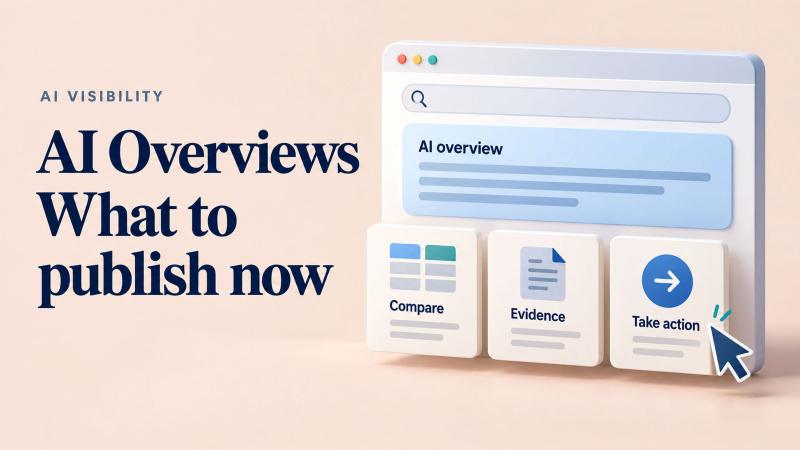

Ask an answer engine a question and it replies in a paragraph, with two or three links underneath. Those links are the whole game now. A page that is cited gets read; a page that is merely ranked may never be seen.
The engines do not publish their scoring, and anyone who claims to know the recipe is guessing. What can be known is how they gather candidates, what a page has to give them before it can be quoted, and which signals a machine can actually read. This guide covers that, with this site as the worked example.
Answer engines search first
None of the major assistants has its own private map of the web. When a question needs current information, the assistant runs a web search, reads a handful of the results, and composes an answer from what it read. Google's assistant draws on Google's index, and the others draw on Bing's index or an index of their own. Google says as much in its guidance on AI features in Search: there is no special markup for being included, and the same practices that get a page indexed and understood apply.
That has a plain consequence. A page that is not indexed, or that ranks nowhere for the question, is never a candidate. Everything below assumes the ordinary work of search is done: the page is reachable, indexable, fast enough, and about one thing.
What the engine needs from a page before it can quote it
An answer is assembled from passages, not from pages. The engine wants a sentence or a short paragraph that answers the question on its own, without the reader having to scroll for context. Four things make a passage usable.
One clear answer, near the top
State the fact in the first screen: the date, the number, the rule, the decision. A guide that takes six paragraphs to reach its point may still rank, but the engine will lift the fact from a competitor that stated it plainly.
Facts that keep their meaning when lifted
"The deadline is April 26, 2027" survives being quoted. "The deadline is next April" does not. Write dates in full, name the thing you are talking about in the sentence itself, and avoid pronouns that point at an earlier paragraph.
A date and a person
A page with a published date, a modified date and a named author is easier to trust than one without, for a reader and for a machine. Engines prefer current pages for questions about deadlines and prices, and the dates are how they tell.
Consistency across the site
If your service page says one thing and your post says another, the engine has no way to choose, and may choose neither. The number that matters should appear once, in one place, and be linked from everywhere else.
The signals a machine can read
These are the parts of a page that are meant for software rather than people. Each is small, and each is checked in this site's build before a page goes live.
| Signal | What it tells the engine | Where it lives on this site |
|---|---|---|
| Title and description | What the page is about, in the words people search for | The Search fields on every page and post |
| Headings | The structure: which passage belongs to which question | H2 and H3 in the body, which also build the "In this guide" list |
| Article schema | Headline, dates, author, publisher, image, section and keywords, as data | Generated for every post from its fields |
| Organization schema | Who publishes the site and how to reach them | On every page |
| Canonical address | Which of several addresses is the real one | On every page |
| Sitemap and feed | What exists, and what is new | sitemap.xml with dates; rss.xml with every post |
| Alt text | What an image shows, including any words printed in it | Written by the author on the media item |
| llms.txt | A plain-text index of the site for language models | Generated at build time; see below |
A word on llms.txt
The file is cheap to publish, and this site publishes one. The evidence that it changes anything is thin: the studies published so far, covering hundreds of thousands of domains, found no measurable effect on citations, and no major provider has said it reads the file. Publish it because it costs nothing, and do not expect it to do the work of the table above.
What does not help
- Repeating the keyword. The engines read meaning, not density. A page that says "Drupal hosting cost" eleven times reads worse to both audiences.
- Accessibility overlays. A widget changes how a page looks to some visitors. It changes nothing about the HTML an engine reads. The FTC's order against one vendor, and what to do instead, is in Accessibility overlays after the FTC's accessiBe order.
- FAQ and HowTo markup. Google now shows those rich results only for a few kinds of site. On a company site the markup adds noise and no benefit.
- Text nobody can see. Hidden passages written for machines are treated as what they are.
- Claims without a source. A number with no link behind it is a number the engine cannot check, and a reader cannot either.
How this site does it
Every post has a search title and a search description, filled by the author. The build turns the post's fields into Article schema with the author, both dates, the image and the keywords, and puts the site's Organization schema on every page. A sitemap with modification dates and a feed with every post are regenerated on each build, along with the llms.txt index. The accessibility gate rejects a page with a broken heading order or a missing alt text, so the structure an engine reads is the structure a screen reader gets.
None of that guarantees a citation. It removes the reasons a page would be passed over.
What to measure
- Click-through rate by query, not rank. In Search Console, a query whose impressions hold while clicks fall is one where an AI answer now sits above you. That list is where to write. What to write for those queries is the subject of AI Overviews traffic decline: what to publish now.
- Referrals from answer engines. Visits arriving from the assistants' own domains appear in analytics as referrals. Small numbers, but they show which pages are being cited.
- A citation sample. Once a month, ask the assistants the ten questions your pages answer, and note which sources they cite. It is manual, and it is the only direct measure there is.
- Branded searches. People who saw your name in an answer often search for it afterwards. A rising count is the quiet sign the work is landing.
The checklist
- The page is indexed and ranks somewhere for the question.
- The answer is in the first screen, in a sentence that stands alone.
- Dates are written in full; the author is named; the modified date is real.
- The search title carries the phrase; the description is one or two full sentences.
- Headings follow the questions; tables have header rows; images have alt text.
- Article and Organization schema are present and match the page.
- The number that matters appears in one place and is linked from the rest.
- Every figure has a source a reader can open.
Our accessibility and AI visibility service does this as a project: the audit of what the engines can read today, the fixes in the templates and the fields, and the monthly measurement afterwards.