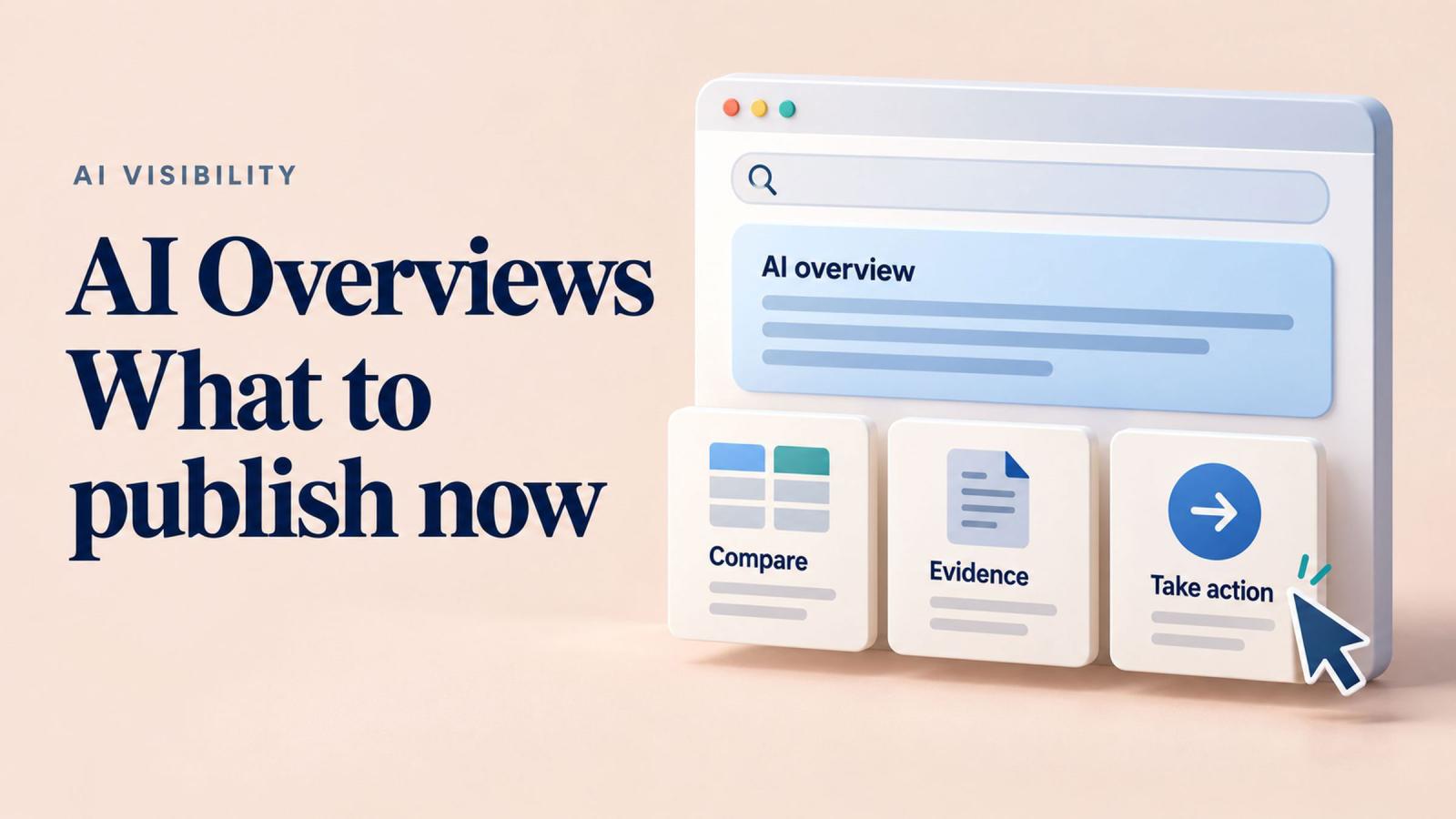
Your admissions guide can still appear in search while fewer prospective students reach it. The results page may already explain the entry requirements, summarize the course and suggest what to do next.
The same pattern affects public services, healthcare information and business research. A useful answer can reach someone without bringing them to the organization that published it.
The response should start with the content itself. Publish clear answers supported by original evidence, then give visitors something useful to do with that information: compare options, check eligibility, explore a dataset, calculate a cost or complete an application.
That gives your website a purpose beyond repeating an answer someone has already read.
What changed on the search results page
Search has answered simple questions directly for years through snippets, maps and information panels.
AI Overviews extend that behavior. They can combine information from several sources into a single response, with supporting links. Someone who previously opened three pages may now read one summary.
Google explains that its AI features can run related searches across subtopics when assembling a response. The pages selected as supporting sources can therefore differ from the familiar list of results for the original query. Google’s explanation of AI search features.
An organic ranking still matters. But its position alone does not tell you how much attention remains available around it.
What the traffic research actually tells us
Similarweb’s June 2026 analysis reported that approximately 68% of Google searches ended without a website click, based on its clickstream research. That is a broad search-behavior estimate, not a predicted traffic loss for an individual institution. Similarweb’s zero-click analysis.
More specific research shows why AI Overviews deserve attention:
| Study | Finding | What it measures |
|---|---|---|
| Pew Research Center, published July 2025 | Users clicked a traditional result in 8% of visits with an AI summary, compared with 15% without one. | Browsing behavior associated with searches by 900 U.S. adults. |
| Seer Interactive, Q3 2025 comparison | Brands cited in an AI Overview had 35% higher organic CTR than those not cited: 0.70% versus 0.52%. | Average click-through rates within Seer’s selected query and client dataset. |
Sources: Pew’s study and methodology, Seer’s analysis.
The citation advantage needs context. Seer examined 3,119 informational and educational search terms across 42 client organizations. Its findings show an association, not proof that obtaining a citation will increase your clicks by 35%.
Nor does being cited guarantee a visit. Pew found that users clicked a link within an AI summary in just 1% of visits to search pages containing one.
These findings justify investigating your own exposure. They do not establish that every traffic decline comes from AI Overviews.
Publish pages with a reason to visit
A definition is easy to summarize. A well-supported decision, a detailed result or a useful tool gives someone more reason to open the source.
The following are publishing priorities to test, rather than categories guaranteed to retain traffic.
| Page type | What to publish | Why someone may still visit |
|---|---|---|
| Comparisons | Options, costs, eligibility, limitations and selection criteria. | The reader needs to decide which option fits their circumstances. |
| Case studies | The problem, constraints, work performed and measured outcome. | The reader wants evidence and implementation detail. |
| Pages with meaningful numbers | Fees, processing times, budgets, results and dated benchmarks. | The reader needs the source, assumptions or current value. |
| Task pages and tools | Applications, calculators, booking, datasets and practical downloads. | The visitor needs to complete something. |
Comparisons should help someone choose
A university can compare part-time and full-time routes through a program. A public agency can explain which permit applies to which project. A nonprofit can compare ways to participate or support its work.
Use the criteria that affect the decision: cost, time, eligibility, exclusions and the next step.
Include the circumstances in which an option is unsuitable. A comparison that always reaches the same promotional conclusion leaves the reader with more work to do.
AI can summarize a comparison, too. The complete table, supporting evidence and ability to act are the reasons to visit.
Case studies should contain evidence only you can provide
An institution has access to material a general summary does not: project decisions, implementation records, service improvements and lessons learned.
Publish the starting condition, what changed, how the outcome was measured and what remains unresolved. Where appropriate, include a diagram, sample deliverable or method that another team can examine.
Avoid attaching a percentage to a vague success claim. Explain the baseline, period and measurement. If the result is estimated, label it as an estimate.
A credible case study can help a reader assess whether your experience applies to their problem.
Numbers need context
A page with a number is useful when the number answers a real question.
Publish the current fee, the expected processing time, the cost assumptions or the size of the group studied. Put the date, scope and source beside it.
For example, “35% higher organic CTR” is incomplete on its own. “In Seer’s Q3 2025 dataset, cited brands averaged 0.70% organic CTR versus 0.52% for non-cited brands” preserves the comparison and its limits.
A number in a headline does not create authority. The evidence behind it does.
Make the page easy to understand and cite
How the engines choose a passage, and which signals they can actually read, is covered in How an answer engine decides what to cite.
There is no guaranteed recipe for an AI Overview citation. There are practical improvements that make a page clearer for readers and easier for search systems to interpret.
Put one clear answer near the top
Open with the answer to the page’s main question. Follow it with the conditions, evidence and next steps.
A service page should explain who can use the service and what they need to do. A comparison should state the main trade-off. A research page should identify its finding and the population it describes.
Readers should be able to establish relevance before working through institutional background.
Write facts that retain their meaning when quoted
Keep the subject, finding and essential qualification together.
Sentences such as “This increased significantly” depend on surrounding text. Naming what increased, over which period and according to which source makes the statement more useful.
Do not remove caveats to make a sentence easier to extract. For institutional information, an answer that loses an eligibility condition or geographic limit can mislead the reader.
Identify the people responsible
Give articles a real author or clearly identified institutional owner. Where subject expertise matters, identify the reviewer and explain their relevant role.
Link to a useful profile rather than a name with no context. Keep publication and review dates accurate.
Google’s guidance encourages clear sourcing, evidence of expertise and information about who created the content. These are practices that help establish trust, rather than a promise of AI placement. Google’s people-first content guidance.
Use accurate structured data
For articles, appropriate structured data can describe the headline, author, image and publication or modification dates. Google says this helps it understand the page and may improve how article information appears in search. Google’s Article structured-data guidance.
The markup must describe what visitors can actually see.
Google also states that no special schema or additional technical markup is required for AI Overviews. A supporting page must be indexed and eligible to appear in Search with a snippet; meeting those conditions does not guarantee selection. Google’s AI feature requirements.
Keep the important information accessible
Use descriptive headings, meaningful links and properly marked-up tables. Put essential facts in readable text rather than leaving them only inside an image.
These choices help people navigate and understand the page. They also make its structure more explicit. Accessibility deserves attention on its own merits; it should not be sold as a guaranteed AI citation technique.
Measure click-through rate by query
A ranking report cannot tell you whether someone still clicked.
In Search Console, examine clicks, impressions and click-through rate by query and landing page, with comparable device, country and date filters. CTR is clicks divided by impressions. Keep average position available as diagnostic context. Search Console’s reporting guidance.
Consider this hypothetical example:
| Metric | Earlier period | Later period |
|---|---|---|
| Impressions | 10,000 | 10,000 |
| Average position | 3 | 3 |
| Clicks | 100 | 70 |
| CTR | 1.0% | 0.7% |
Visibility and average position appear unchanged, but the page received 30% fewer clicks.
That warrants inspecting the results page. It does not prove an AI Overview caused the difference. Ads, competing results, changed titles and shifts in search intent can also affect CTR.
Group queries by purpose: general information, comparison, institution name and task completion. Compare similar periods and account for admissions cycles, campaigns or seasonal services.
Track outcomes and citation accuracy as well
Google includes AI Overview and AI Mode activity within Search Console’s overall Web performance reporting. That aggregate data does not provide a clean, separate AI Overview attribution report. Google’s measurement guidance.
Use several measures together:
- Query-level clicks and CTR: where search traffic is changing.
- Landing-page outcomes: completed applications, bookings, qualified inquiries or useful downloads.
- Observed citations: whether your pages appear for a consistent sample of relevant searches.
- Answer accuracy: whether those answers preserve your current facts, dates and limitations.
Record the date, location and device when checking results. A single search is a snapshot, not a stable visibility score.
Measure conversions at the landing-page level without pretending you can identify the exact search query behind every conversion.
For a public institution, an accurate answer about office hours may successfully serve someone without a click. An incomplete answer about eligibility may create a problem even if it produces visibility. Traffic alone cannot distinguish those outcomes.
What to change this month
Start with the pages that already serve important questions.
In the first week, identify a small group with meaningful impressions and declining CTR. Inspect their current search results and check for technical problems before attributing losses to AI.
Over the next two weeks, improve those pages. Add a direct opening answer, current evidence, a responsible author or department, and a useful next step. Where the topic supports it, develop a comparison, documented case study or practical tool.
In the final week, verify the published pages, record the changes and establish a baseline for continued measurement. Search effects may take longer than a month to assess.
The next article on your calendar should contain something your institution is well placed to explain, prove or help someone complete.
Our Accessibility & AI visibility services bring those priorities together: clear content, accessible pages, sound technical implementation and measurement tied to what visitors need.