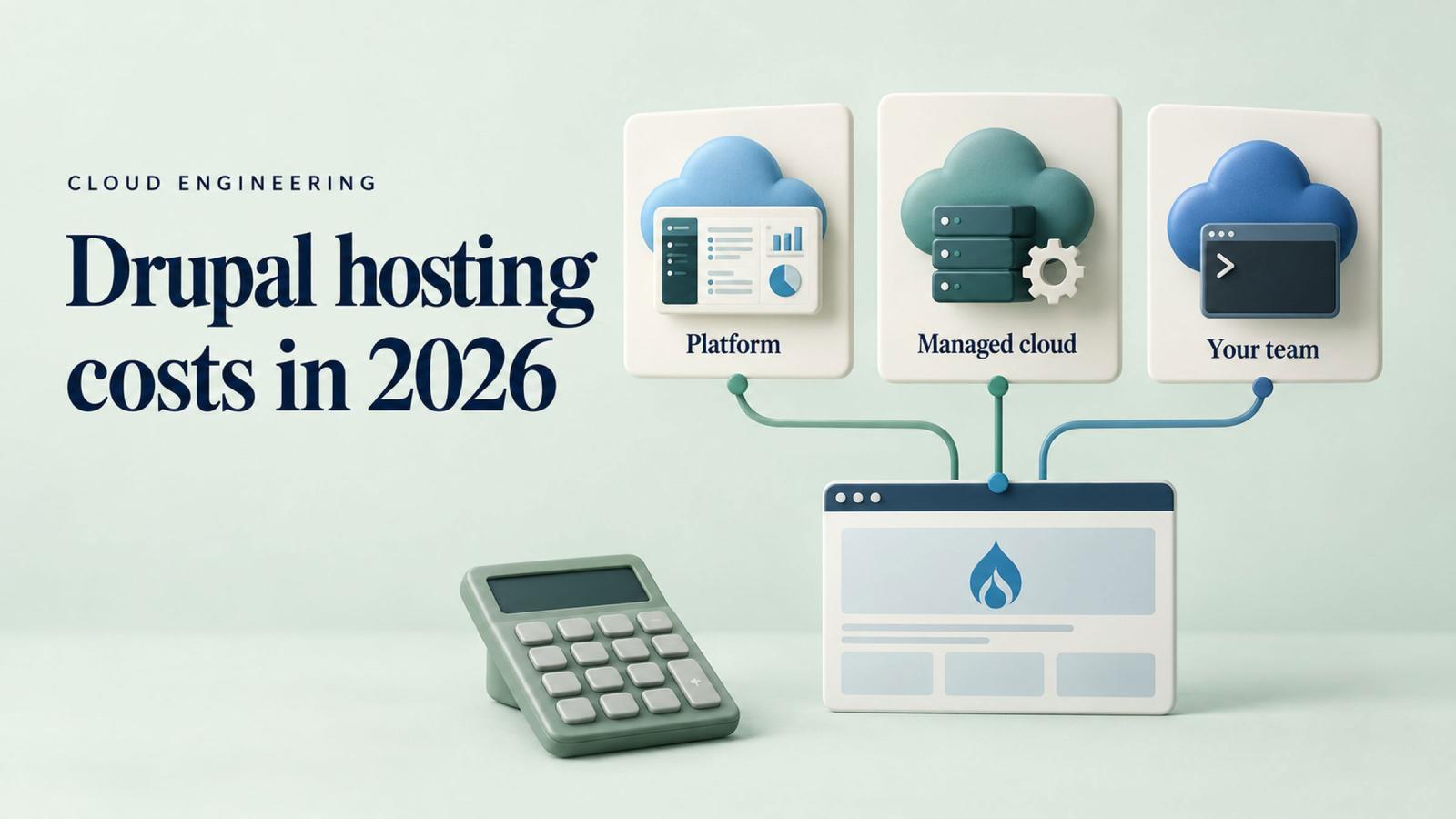
A Drupal hosting quote can be $41 a month or a negotiated annual contract. Both may be reasonable. They are rarely buying the same thing.
One pays for a small website on a standardized platform. Another might include production infrastructure, multiple development environments, incident response, security documentation and a contractual availability commitment.
A third option puts the hosting platform inside your organization’s own cloud account, with an engineering partner managing it.
For government agencies and nonprofits, the useful comparison is the full operating cost: infrastructure, tools, maintenance and the people responsible when something goes wrong.
What Drupal hosting costs in 2026
Pantheon publishes a Basic plan at approximately $41 per month, while Acquia’s U.S. self-service page lists a Personal plan at $148 per month. These are entry prices, not estimates for a typical institutional website.
The following prices were checked in September 2026. All figures are in U.S. dollars.
| Provider and plan | Published monthly price | What the price represents |
|---|---|---|
| Pantheon Basic | $41, at the annual rate | Entry hosting with a listed 35,000 monthly visit allowance and 20 GB storage. |
| Pantheon Performance Small | $160, prepaid annually | A higher-capability plan with 35,000 monthly visits and 30 GB storage. |
| Pantheon Performance Medium | $275, prepaid annually | A listed 70,000 monthly visits, 350,000 pages served and 50 GB storage. |
| Acquia Professional Personal, U.S. | $148 | A self-service plan intended for personal Drupal sites and blogs. |
| Acquia Professional Small, U.S. | $296 | A self-service plan with development and staging environments and 100 GB storage. |
| Enterprise offerings | Custom quote | Capacity, support commitments, security requirements and additional services affect the contract. |
Sources: Pantheon Basic, Pantheon Performance, Acquia self-service pricing.
Acquia’s main Cloud Platform pricing page presents annual subscription tiers without publishing dollar amounts. Its Professional billing documentation also describes subscription and usage-based resource charges. Confirm the available product, capacity and billing terms before treating an advertised starting price as a complete monthly bill. Acquia subscription tiers, Professional billing.
Three ways to buy Drupal hosting
1. A platform host runs the environment
With a platform host such as Pantheon or Acquia, you buy access to an established hosting environment and its operating tools.
The provider controls the underlying infrastructure. Your team works through the platform’s supported deployment process, permissions and services.
This can remove substantial work from a small team. Pantheon, for example, packages development workflows, a dashboard, backups and a content delivery network into its offering. The available features and support depend on the plan. Pantheon’s hosting overview.
You still need someone responsible for the Drupal application: reviewing updates, testing releases, maintaining custom code and resolving problems in your integrations.
2. A partner manages a platform in your cloud account
Here, your organization holds the AWS, Azure or other cloud account. An engineering partner builds and operates the hosting environment inside it.
You pay the cloud provider for infrastructure and the partner for an agreed service. Automation or management software may add another cost.
The distinction is account control. Billing, administrative ownership and access to the deployed resources remain with your organization. The partner receives the permissions needed to do its work.
This is the model we favor when a client needs infrastructure ownership and ongoing engineering support. Its value depends on a clear service agreement, repeatable deployment and documentation another team can use.
3. Your own account, operated by your engineer
Your team takes responsibility for the environment directly. An employee or contractor handles provisioning, monitoring, deployments, recovery and capacity planning.
This can work well when your organization already operates cloud services. It becomes harder to justify when one website is the only reason to maintain that expertise.
AWS’s shared responsibility model makes the division clear: AWS operates the underlying cloud infrastructure, while customers retain responsibilities that vary with the services they select. Renting cloud resources does not remove application and configuration work. AWS shared responsibility model.
A cost comparison for an institutional Drupal site
To make the comparison concrete, consider a hypothetical nonprofit or public information website with:
- Approximately 50,000 monthly visits and 250,000 pages served.
- Mostly public, cacheable content.
- Around 30 GB of files.
- Production, development and staging environments.
- Routine updates, backup checks and business-hours engineering support.
This example does not include a regulated-data environment, dedicated round-the-clock application support or a bespoke disaster recovery service.
The table below is a budgeting exercise, not a market average or a Dynamosys quote. It uses an illustrative engineering rate of $150 per hour, a $350 cloud allowance and a $1,000 managed-operations allowance. Actual cloud costs require a sized architecture.
| Hosting arrangement | Hosting and infrastructure per month | Routine engineering or management | Illustrative monthly total |
|---|---|---|---|
| Pantheon Performance Medium | $275 published annual-rate price | 4 hours × $150 = $600 | $875 |
| Acquia, appropriately sized plan | Provider quote | 4 hours × $150 = $600 | Quoted hosting cost + $600 |
| Managed platform in your account | $350 allowance | $1,000 operations allowance + $600 application maintenance | $1,950 |
| Your account with your engineer | $350 allowance | 12 hours × $150 = $1,800, covering infrastructure and application work | $2,150 |
The Pantheon example fits the plan’s published traffic and storage allowances, but still needs workload testing. Its annual-rate hosting price also means an annual payment commitment. The Acquia row remains quote-based because an entry price does not establish the capacity or service package this site needs.
Under these assumptions, Pantheon comes to $10,500 a year, managed hosting in the client’s account to $23,400, and the engineer-operated option to $25,800. These totals exclude setup, migration, taxes, major upgrades and additional services.
For a single modest website, the platform host can be the economical choice. Account ownership earns its place through requirements and operational benefits; it does not automatically produce a lower bill.
What the hosting premium buys
The difference between raw infrastructure cost and a managed hosting bill can pay for useful work.
Operating tools. Deployment workflows, environment cloning, backups, monitoring and access management take time to assemble and maintain. A working dashboard represents engineering someone else has already done.
Support and escalation. There is value in having a team that understands the hosting environment. Check whether the agreement covers platform incidents, application troubleshooting or both. A response-time commitment also differs from a promise to resolve every incident within that time.
Security evidence. An established provider may supply audit reports, documented controls and material your procurement team can reuse. For an organization with a lengthy supplier review process, that can save considerable staff time.
Capacity management. Caching, redundancy and scaling features can reduce operational work, provided the selected plan includes what your application needs.
These benefits deserve a place in the comparison. Ask each provider to identify which are included, which cost extra and which remain your responsibility.
What the premium does not buy
A hosting contract does not necessarily include Drupal upgrades, repairs to custom modules, accessibility remediation or testing of a donation form after an update.
Acquia explicitly describes security as a shared responsibility and places application security responsibilities on the subscriber. It also notes that processing certain regulated information requires additional contractual terms. Acquia security and compliance documentation.
For government buyers, evaluate the specific service and agreement offered. A security logo on a provider’s website does not establish that every product or configuration meets your requirements.
Backup availability deserves similar scrutiny. Ask how restores work, who performs them and when your team last tested recovery. A backup feature and a demonstrated recovery process are different deliverables.
When Pantheon or Acquia is the right call
A platform host is a strong candidate when your requirements fit its supported workflows and you want to avoid building a separate infrastructure operation.
Pantheon merits consideration for teams that value a consistent development process and can fit their workload within its plans. A nonprofit with a small web team may reasonably prefer a predictable platform bill to managing another engineering supplier.
Acquia merits consideration when its enterprise support, governance and procurement capabilities address requirements your organization already has. Compare the actual proposed tier: its published enterprise offerings distinguish support response commitments, environments and additional services. Acquia Cloud Platform tiers.
In either case, ask the provider to price your expected workload and a realistic growth scenario. Include campaign peaks, additional environments and the support level your team will use.
When your own cloud account makes sense
Account ownership becomes more valuable when Drupal needs to operate within an existing technology environment.
That might mean connecting to private services, using central identity controls, following an established logging policy or charging infrastructure to an existing cloud budget.
It can also help an organization change engineering partners. If the account, repositories, deployment definitions and documentation belong to the client, a new partner can potentially take over the existing environment.
That handover still requires preparation. Cloud services, custom automation and poorly documented configurations can all create dependencies. Ownership works best when another qualified team can understand and operate what has been built.
For a portfolio of websites, shared infrastructure and automation may improve the economics. Confirm this through a measured pilot rather than applying a promised savings percentage to every site.
The reported Voice of America figures
A DevPanel-authored case study published on Drupal.org in September 2025 identifies the Voice of America digital team and describes a hosting evaluation for its Drupal estate.
The case study reports projected Acquia hosting of approximately $1 million annually for four sites, compared with projected hosting of approximately $200,000 annually using DevPanel in the agency’s own AWS account. It characterizes the difference as savings exceeding 75%. Read the published case study.
These are vendor-reported figures, and the account includes projections. They should not be presented as independently verified invoices, an equivalent-scope price comparison or a savings forecast for another organization.
The example supports investigating an alternative architecture at scale. Your own decision still needs comparable requirements, measured performance and a complete operating budget.
Build the budget around three years
Before choosing a provider, request a three-year view that includes:
- Setup and migration: discovery, environment configuration, testing, content synchronization and temporary overlap between hosts.
- Recurring operations: infrastructure, subscriptions, routine Drupal maintenance, monitoring and incident coverage.
- Growth and renewal: traffic increases, storage, new sites, additional environments and contract changes.
- Exit work: data export, documentation, handover and any migration needed to change providers.
For nonprofits, show any eligible cloud credits separately from the underlying running cost. A temporary credit can help fund a transition, but the operating plan needs to survive its expiration.
Then name the people responsible for updates, incidents and recovery under each proposal. A low price with unassigned work is an incomplete budget.
At Dynamosys, our Cloud engineering services focus on building and operating infrastructure in the client’s own account. If that model fits your requirements, the next step is a scoped comparison using your current bill, traffic profile and service obligations.